Editorial Desk · Reviewed against published dermatology literature
Sources: Dr. Whitney Bowe MD, Dr. Heather Rogers MD, ScienceDirect, PubMed · June 2026

Reason 1
Your skin is losing collagen at a rate most women are never told about
Collagen is the protein responsible for the structural firmness and surface evenness of skin. It is what gives skin the smooth, taut canvas that foundation glides across and stays on. And after menopause, it disappears faster than almost any other physiological change in the body
Up to 30% of dermal collagen lost in the first 5 years after menopause
Skin collagen content decreases at a rate of approximately 1 to 2 percent per year in the early postmenopausal period. Skin thickness diminishes, barrier function weakens, and moisture retention falters.
Medscape, 2026 — citing established dermatology literature on estrogen deficiency and skin physiology

Reason 2
Dead skin cells are accumulating on your surface and scattering light in every direction
In your twenties, skin renewed itself roughly every 20 days. New cells pushed old ones to the surface, where they shed naturally, leaving a smooth, reflective layer that foundation could glide across and adhere to evenly. That cycle slows significantly with age, and particularly during perimenopause.
As the rate of skin cell turnover slows down, dead cells will accumulate on the surface of your skin. This buildup makes skin feel rough and causes the complexion to look dull and less radiant, since those piled-up dead cells scatter light in all directions.
Dr. Whitney Bowe, MD — board-certified dermatologist, creator of the Skin Cycling method, drwhitneybowebeauty.com, September 2025
Skin renewal cycle: 20 days at 20 years old vs. 45 days at 40 years old

Reason 3
Ceramide production has dropped and the barrier holding everything together has weakened
Ceramides are the lipid molecules that form the microscopic cement between skin cells, sealing the outer barrier and holding moisture in. They are what makes skin feel smooth, look even, and hold anything applied on top of it uniformly. During and after menopause, ceramide production falls measurably. Research published in 2026 on Medscape confirms that menopause induces specific changes to the stratum corneum ceramide profile: ceramides become shorter in length and lower in abundance, directly impairing barrier function.
When the barrier weakens, the surface of the skin becomes microscopically porous, rather like raw wood versus sealed wood. Foundation applied over a depleted barrier cannot adhere uniformly. It separates in the dry patches, slides in the compensatory oily zones, and settles into every crease because there is no longer a sealed, consistent surface holding it in place.
When the barrier weakens, the surface of the skin becomes microscopically porous, rather like raw wood versus sealed wood. Foundation applied over a depleted barrier cannot adhere uniformly. It separates in the dry patches, slides in the compensatory oily zones, and settles into every crease because there is no longer a sealed, consistent surface holding it in place.

Reason 4
Your skin now needs more from every product but tolerates far less than it used to
This is the paradox that dermatologists see in their clinics constantly: the primer that worked perfectly for a decade now breaks her out. The serum she has used for years now stings. The moisturiser she layered under foundation now makes it slide. It is not coincidence and it is not imagined. As the barrier function weakens, the skin's tolerance threshold drops alongside it. Products that were safely buffered by a stronger barrier are now making more direct contact with reactive tissue underneath.
Dr. Rogers has built her entire product philosophy around this principle, stating that as the skin ages, it needs more but tolerates less. That truth guides every formula she creates. The consequence for your makeup routine is a narrow window that keeps closing: the ingredients that would prepare the skin well are often the ones the compromised barrier now reacts to, and the safer alternatives do not give the surface what it needs. Most women in this position keep adding and subtracting products in frustration, not realising that the problem is the sequence and the biology, not their product selection.

Reason 5
Your morning routine may be doing too much, too late
This is the one nobody says out loud, because saying it would be commercially catastrophic. Foundation formulas are developed, tested, and photographed on younger skin with active sebum production, intact ceramide levels, and a renewal cycle that runs every 20 days. They perform beautifully in that environment. They were not reformulated for a barrier that is depleted, a renewal cycle that has slowed to 45 days, or a collagen layer that has lost a third of its structure.
The result is a growing, largely silent population of women who buy and discard foundation after foundation, each time concluding that they found the wrong one. The beauty industry profits from this cycle. The moment a woman understands that the problem is not her foundation but the surface beneath it, she stops buying the next product and addresses the actual cause. There is no financial incentive to provide her with that information.
The gap is not a consumer failure. It is an information gap built into the structure of an industry that benefits from her continuing to look for the answer in the next foundation bottle.
What the research actually points to
Prepare the canvas before you paint it. The step the beauty industry left out.
The dermatological literature is consistent on what actually addresses these five changes: barrier repair and surface preparation before foundation is applied. Not a new foundation. Not a primer sitting on top of the same unprepared skin. A step that works at the level of what has actually changed.
Three ingredients appear across the clinical research for perimenopausal and menopausal skin preparation:
- Hyaluronic acid draws moisture into the skin's surface layers and holds it there. In clinical trials on older adults with dry skin, hyaluronic acid formulations showed meaningful hydration improvements, but only when paired with occlusive or lipid-based ingredients to seal that moisture in.
- Niacinamide does something no moisturiser can do from the outside: it upregulates the skin's own ceramide production machinery from within. Research published in peer-reviewed dermatology literature confirms that topical niacinamide increases the biosynthesis of ceramides and other stratum corneum lipids.
- Collagen-supporting peptides address the structural layer beneath the surface, supporting the firmness and texture that gives foundation a consistent surface to adhere to. As a topical ingredient, collagen-derived compounds provide surface conditioning, temporary smoothness, and a more plump-looking finish.
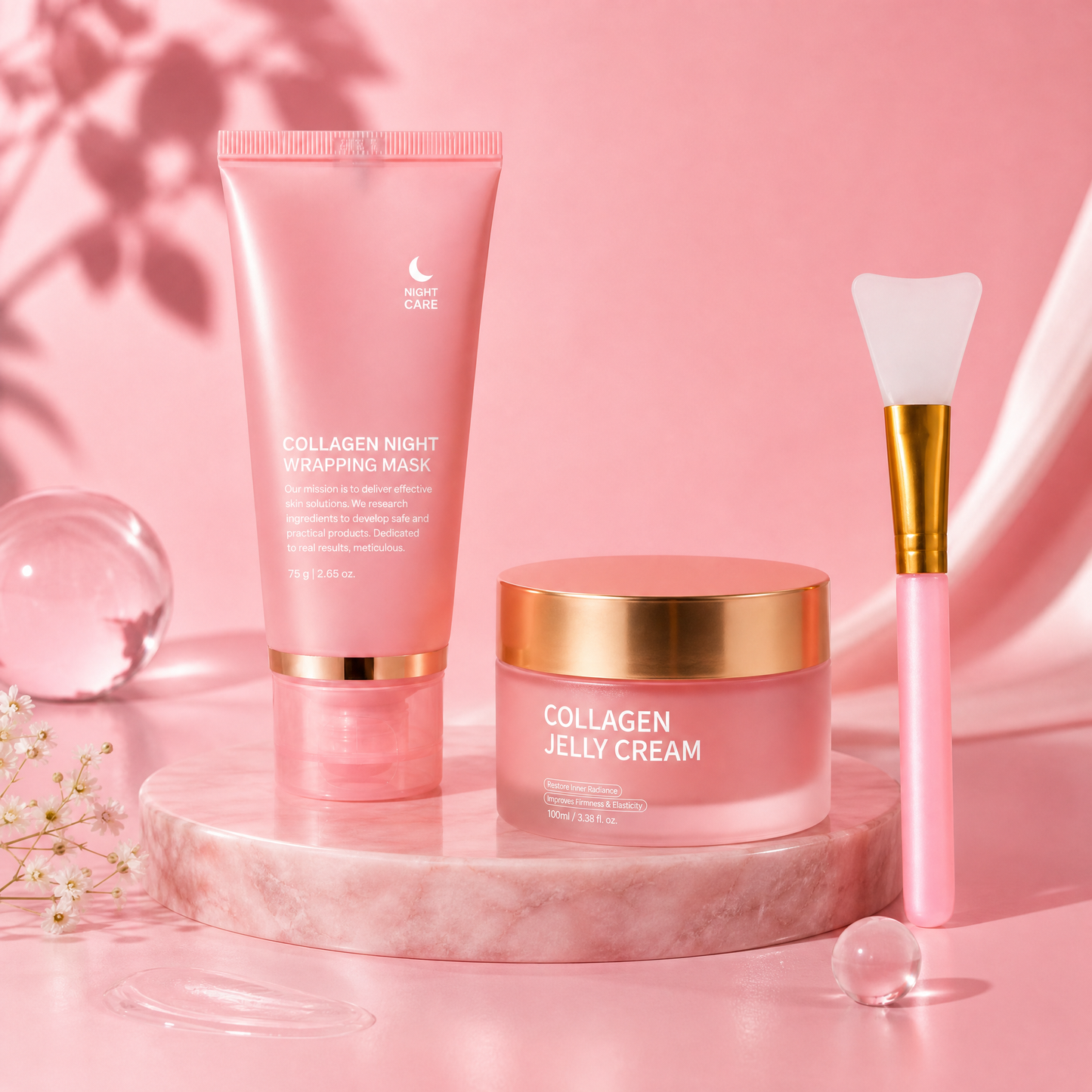
Velari Co.'s Makeup Prep Duo is built around exactly this sequence. The two-step system addresses barrier repair at both the overnight stage, with the hydrating mask, and the morning preparation stage, with the lightweight gel applied before foundation. Together they give your foundation the surface it was designed for.